(CW: bugs, death/afterlife)
Classification
Affinities
- Null (neutral, mixed)
- Fire
- Earth
- Spirit (ghosts, death)
- Light (includes lightning/electricity)
- Water
- Nature (life, plants)
- Melee (warriors, martial arts)
- Air
- Metal
- Mind
- Dark (includes spacetime)
- Ice
- Toxic (includes acid)
Classes
- Beast (mammals)
- Bird
- Reptile (includes amphibians)
- Fish
- Bug (arthropods)
- Worm (non-arthropod invertebrates)
- Plant (includes fungi)
- Monster (mythical beasts, hybrids, kaiju)
- Dragon
- Fey
- Humanoid
- Hard (hard-bodied inorganic)
- Soft (soft-bodied inorganic, incorporeal)
- Outsider (alien, eldritch)
Creature list
Zardust → Staraga → Asteragon
Classification: Light Reptile/Dragon
Appearance
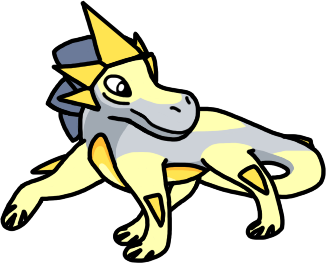
Zardust is a small squat quadrupedal reptile. The body is yellowish and grey. On the head are five yellow angular horns: a large one atop the head, and two small ones behind each eye. On the back of the head is a short "mane" composed of bluish overlapping plates. The underside of the body has a smooth, sparkly appearance.
Staraga is larger than Zardust, and has a more upright posture. The body is yellow and blue. Atop the head are three horns, and there is one small horn behind each eye. The mane is longer and darker than Zardust's.
Asteragon is larger than Staraga. The body is yellow and deep blue, with red details. Atop the head are two long horns, with a smaller horn in between, and another behind each eye. The mane is long and flowing, reaching down to the tail.
Biology
The crystal-like parts of their bodies absorb EM radiation. They spend a lot of time lying around absorbing light and heat for sustinence.
If they begin to act strangely, it may mean that an eclipse is on the way.
They are good at climbing slopes and crossing rough terrain. They are also surprisingly good swimmers.
They can use the energy they absorb for offense, generating jolts of energy or wreathing their bodies in plasma.
Habitat
They live in mountain valleys and on sunny mountain sides. They sometimes gather at high viewpoints to observe the skies and landscape.
They hide away and sleep when it's cold or dark.
Ashee → Hesprite
Classification: Fire Fey/Soft
Appearance
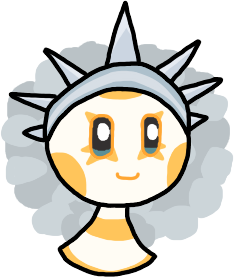
Ashee is a small beige and orange sprite resembling a limbless doll with a dress, surrounded by a cloud of grey soot. Atop the round head is a silver radiate crown.
Hesprite is larger than Ashee, and has short arms and legs. Adorning the body are loose parts that resemble hair, and the dress is more colourful and elaborate. Around the head is a golden solar crown with a large disk and many rays.
Biology
They can generate heat with their bodies. They glow brighter and turn whiter as they heat up.
Due to being very light, Ashee can float on the air. It often seems to disappear when no one is looking.
Ashee is attracted to sources of heat. It may enter people's houses in search of a fireplace or stove.
Hesprite doesn't readily bond with people, but it is very loyal to families once its trust is earned. It is said to bring good luck, but to harm one would invite disaster.
Habitat
They usually live in dark forests and heaths, far away from people. In rural areas, they may visit villages if it's not busy. Sometimes, they may even live in or around people's houses.
Nimmold → Noxion
Classification: Toxic Bug
Appearance
Nimmold is a small insect with a flattened white and red body and large eyes.
Noxion is bulkier than Nimmold. Many long, heavy black tubes cover up most of the white body. The legs are small and hard to see.
Biology
They bite into plants and drink the sap, leaving open wounds that invite infection.
Nimmold is fast, but ultimately groundbound. In order to travel easily, it rides on the bodies of larger beings.
Noxion converts the sap it drinks into venom, stored in the tubes on its back. It can release the venom as a foul ooze. Noxion's venom is sometimes purified and used to make paints and cosmetics.
Noxion is slowed by its bulk. It often ends up drinking so much that its venom leaks out.
Habitat
They are found in fields wherever their host plants grow. They mainly feed on fruit trees, so they are also often found in orchards.
They gather in large groups for safety, quickly covering the plants they feed on.
Planurm → Regendurm
Classification: Null Worm
Appearance
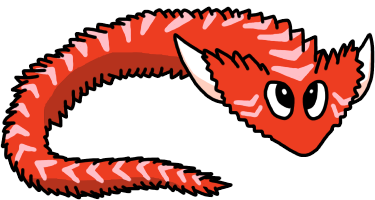
Planurm is a small flat-bodied worm covered in fuzz. The fuzz may be in any one of various bright colours, with small triangular markings in other colours. On the head are two large eyes, and a pair of small tusks, like axe blades, that give the head the shape of an arrowhead.
Regendurm is much larger and bulkier than Planurm. The triangular markings have become prominent stripes and arrowhead markings. The tusks on the head are larger, and the head also bears a pair of long curved antennae.
Biology
They are covered in fuzz, but it doesn't feel furry: the fuzz is full of slime to absorb moisture from the air.
They have incredible regenerative capabilities. In fact, if a piece of Regendurm's body is lost, the piece can grow into a whole new Planurm.
Planurm can attack using its small tusks, but Regendurm uses its girth to body slam foes or wrestle them to the ground.
Habitat
Planurm and Regendurm mostly live in swamps and dense forests, due to the need for moisture.
If the environment starts getting too dry, they hide under plants or rocks, or use their tusks to burrow into the ground.
Rodjet → Atmosalpe | Fierosome
Classification: Air Worm (Rodjet/Atmosalpe); Fire Worm (Fierosome)
Appearance
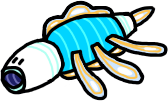
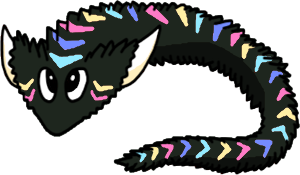
Rodjet has a blue-white gelatinous tube-shaped body, parts of which are transparent. Around the body are thin undulating fins, like those of an eel, as well as small wing-like fins used for steering. Rodjet also has a tail that the metamorphosed forms lack.
Atmosalpe is a giant colony of many Rodjet, joined together into a large thin-walled tube, like a wind sock. The individuals are white and blue.
Fierosome is smaller but bulkier than Atmosalpe, and has a nearly closed bell-shaped formation, with only a small opening at the top. The individuals are an intense blue, with spots and streaks that can flash and change colour.
Biology
They can pump air through their bodies to move very quickly. Even a large Atmosalpe can easily soar through the air. They can also force air through themselves as a means of offense, using bursts of air to incapacitate prey.
Atmosalpe is formed from a colony of Rodjet, whose bodies are physically joined. Sometimes in warm environments, Rodjet turn into Fierosome instead of Atmosalpe.
Fierosome generates a lot of light and heat, making it highly visible wherever it shows up. While it can generate heat to attack, the heat is mostly used for propulsion.
Habitat
Rodjet and Atmosalpe may be found over seas and large lakes, while Fierosome is only found over the ocean. They sometimes rest on the water's surface.
Saphri
Classification: Mind Fey/Monster
Appearance
Saphri is a small quadruped with chimeric features, overall looking something like a feline or mustelid. It has dark shiny eyes, long antennae-whiskers, large cat-like ears, and a fluffy tail. The body is mostly covered by light blue-green fur, but some hairless parts expose pale yellow fish-like scales.
Biology
Saphri can sense emotions, and sometimes thoughts, in other beings. It is friendly and playful with kind people whom it can empathise with easily. If threatened, it can use illusions to defend itself.
Most of the time, it sits in trees or floats in the air, but it is quite capable on the ground as well.
Habitat
Saphri plays in lush fields and forests. It usually stays high up in the trees, but it comes down for people it likes.
Zoshuca
Classification: Metal Plant/Hard
Appearance
Zoshuca is a tall tree-like creature. Most of the surface of the body is shiny grey metal, covered in spikes. The body shape is loosely humanoid, with a head bearing spiky green hair and a beard, and two arms ending in spiky green bunches. The number of legs varies.
Biology
Zoshuca moves by slowly shuffling on its roots. Its arms and legs do not bend easily.
Its roots can dig into surfaces and extract minerals. It can be a hazard when it digs into structures and damages them.
Habitat
Zoshuca is sometimes found on dry plains and hills, but is more often found in places where technology is found but humans aren't, such as abandoned settlements, construction sites and power plants.
It prefers hot dry environments, but is capable of withstanding heavy rain.
Greigu
Classification: Metal Soft
Appearance
Greigu is inorganic and amorphous. It may appear as a puddle of silvery-grey slime, but is capable of adopting many different forms. Regardless of form, Greigu always bears the same face, though it may not always be on the same part of the body.
Biology
Greigu is capable of freely changing in shape, colour and texture. It cannot add or lose mass in a controlled manner, so it changes in volume by growing and shrinking internal cavities.
Greigu mimics everything it sees, both animate and inanimate. It copies appearances very accurately, but it isn't very good at copying behaviour. Besides, it usually can't retain a form for very long before getting the urge to shift again.
Habitat
Greigu is mostly found in urban areas. It may also be found underground.
Lobosopod
Classification: Mind Worm/Bug
Appearance
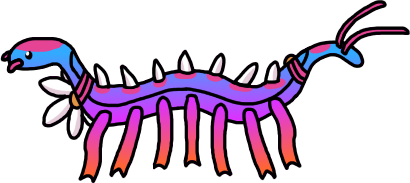
Lobosopod is a small colourful soft-bodied invertebrate with a worm-like body. It has tube-like legs, and short pale spines on its back. On its neck is a white flower-shaped organ. Its tail mirrors its head, but has long antennae.
Biology
Lobosopod's neck organ and spines can change colour and flash brightly. It uses these flashes to mesmerise its prey, but it can create quite an elaborate display of lights, which it sometimes shows off just for entertainment.
The symmetry of Lobosopod's body allows it to easily move around back to front. This way, it can confuse a predator into attacking its tail instead of its head.
Habitat
Lobosopod is found in coastal environments.
Minibara → Capybraque
WIP
Praydoxa → Thanantis → Revenantis
Classification: Spirit Bug
Appearance
Praydoxa is a small, stout bipedal insect with a hunched posture. Its cuticle is dull brown above, and pale underneath. Its large wings encircle its upper body, hiding its arms. Its head is covered by a small hood.
Thanantis is larger and sleeker than Praydoxa, but still usually appears hunched. Its brown parts have become dark grey, while its pale parts have become bluish. Its arms hang below its body. A white scarf is draped around its upper body.
Revenantis is tall and lanky. Its cloak fades between dark grey and sandy beige, but the rest of its body is a striking combination of pale blue and pink. Its forearms bear sharp blades. Its white scarf floats ethereally around its body.
Biology
Praydoxa and Thanantis are shy and elusive. They evade detection using camouflage.
Praydoxa's wings darken after a wildfire, allowing it to hide on burnt wood. If detected, it startles its foe by flashing its wings.
The ever-changing patterns on Revenantis's cloak allow it to hide in plain sight.
They are belived to pray for the spirits of the fallen.
It is believed that Revenantis uses its excellent vision to detect traces of wandering spirits.
Revenantis is known for performing elaborate dances. These dances are believed to put suffering spirits at ease, making it easier for them to pass on.
Habitat
They mainly live in dry savannahs.
Scrumfire → Fritebrand
Classification: Fire Plant/Monster
Appearance
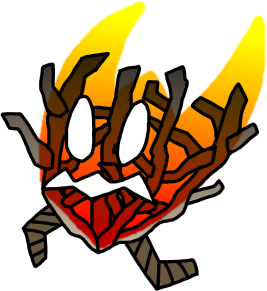
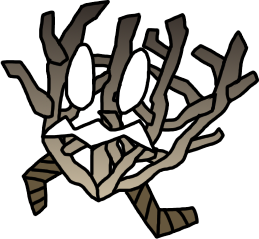
Scrumfire is a small bush-like creature with a roughly cup-shaped body. Its grey-brown branches are typically ablaze, with the flames rising out of its body in large curved points resembling horns. It has no visible leaves. A face is visible within its body, but this face is not physically part of Scrumfire. At the bottom of its body are two stumpy legs.
Fritebrand is much larger than Scrumfire, and its body is more of a heap in shape, thick at the base and tapering towards a peak. It has many root-like legs, and several thin, flexible arms resembling whips. When ablaze, the flames on its head end in several "horns", forming a sort of crown.
Biology
Scrumfire often runs around for seemingly no reason. It may end up wandering a long way from home and getting lost. It is usually solitary, but sometimes many gather together and cause wildfires.
Fritebrand is a terror of people living in dry areas vulnerable to fire. Its mere appearance tends to incite panic.
They have a tendency to burst into flames when stressed. They can keep burning for days on end until something puts them out.
If Fritebrand gets too stressed, it goes into a frenzy, wildly lashing out at its surroundings with its whip-like arms.
Habitat
They are found in dry desert regions on hillsides and in ravines.
Excarab → Instarth → Dynastone
Classification: Earth Bug/Hard
Appearance
Excarab is a large round insect grub. Its body is beige and white, with dark brown appendages. Its head bears large mouthparts. The surface of its body is hard and stony, covered with small lumps and spikes.
Instarth's body is mostly a pale grey-blue. Its eyes are closed. Its legs and mouthparts are curled up, but still capable of moving.
Dynastone is a huge stony beetle. Its body is dark brown and amber. Its head and thorax bear two massive horns, one larger than the other.
Biology
Excarab is slow but incredibly strong. It can throw an opponent many times its size into the air.
Although Instarth spends most of its time curled up unmoving, it possesses an unusual power that lets it levitate.
Dynastone's horns aren't just used for grappling foes: they are also capable of releasing powerful bursts of exotic energy.
Despite its enormous girth, Dynastone can also fly. However, it cannot fly and attack with its energy at the same time.
Habitat
They are mostly found in hilly areas. They can also sometimes be found in caves.
Fahmehnah
WIP
Corcrank
WIP
Tangling → Gigagrowth
Classification: Nature Bug/Monster
Appearance
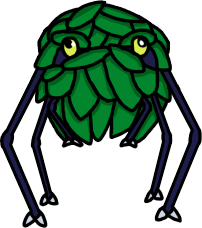
Tangling is a large arthropod with a small boxy dark blue body and six very long limbs (two arms and four legs). Long spiky green leaves and other plants hang down from its body, almost completely obscuring it. Its eyes poke out from among the foliage.
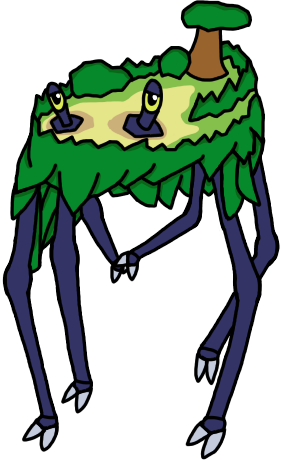
Gigagrowth is much larger than Tangling. Its body has a flat earthy top bearing long streams of vines and whole shrubs and trees.
Biology
Tangling lives in forests among the undergrowth, but when it gets too big, it must leave the forest and wander across the hills and plains. Gigagrowth returns to the forest of its birth only to breed.
All kinds of plants can grow on Gigagrowth. Some daring people climb up onto its back to harvest fruits, herbs and mushrooms.
They tend to avoid confrontation. Tangling is timid and runs away when frightened, but Gigagrowth has little to fear.
They rest while partly burrowed into the ground, making them appear to be plant-covered mounds. Gigagrowth sometimes ends up carrying off smaller creatures by mistake.
Habitat
Tangling is mostly found in upland forests. Gigagrowth wanders a lot, but is often found on hillsides and in mountain valleys.
Dustibel
Classification: Earth Plant
Appearance
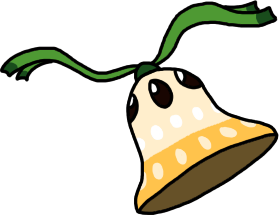
Dustibel is a strange plant-like creature with a beige and yellow dome-shaped body. The inside of the dome is hollow, with a mouth at the top. It has four large eyes around its dome. On top of its dome are two long, thin green ribbon-like appendages.
Biology
Dustibel hangs lightly in the air, floating along and ringing softly as it goes. It often uses its appendages to dangle in raised positions.
It feeds by sucking up small particles from below. It makes it surroundings very clean, but it can sometimes be a pest in large swarms.
Habitat
Dustibel is often found in dry places. It may also be found in urban areas.
Darta → Glidrake → Aerovern
Classification: Air Soft/Dragon
Appearance
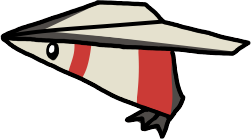
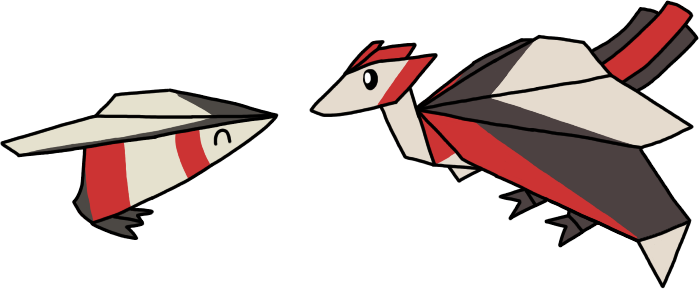
Darta is an artificial creature made of paper. Its body somewhat resembles a paper plane, but with small eyes and stubby feet. Its body is whitish with black and red sections.
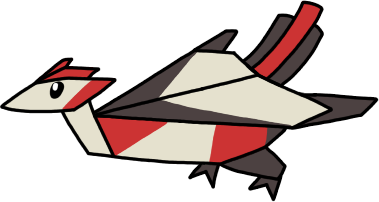
Glidrake is slightly larger than Darta, and its body parts are more well formed. It has a distinct head and longer legs, as well as a short pointy tail. Its wings are larger and more articulate. Three streamers extend from the rear of its body.
Aerovern has very large wings. Its features are more finely detailed than Glidrake's. It has a long tail with many thin streamers.
Biology
They can glide through the air with their aerodynamic bodies. In good conditions, a single flight can last for a very long time before they have to land. If they get wet, they have to spend a long time drying out in the sun before they can fly again.
Darta will gladly play with friendly people, but it doesn't like being roughly handled.
They typically travel in small groups that fly together in formation. It is said that to see a group of Aerovern flying in formation will bring happiness.
Habitat
They can be commonly found in open plains and valleys. They can also be found in urban areas.
They land and hide away if it rains.
Relisword → Destiknight | Shadorigo
Classification: Melee Humanoid/Hard (Relisword, Destiknight); Dark Humanoid/Hard (Shadorigo)
Appearance
Relisword is a robotic creature resembling a short armoured humanoid. Its armour is a mixture of faded red and indigo-blue. The armour has a simple rounded appearance, but it appears damaged or broken in places. The helmet has an open visor. A pair of bright yellowish eyes on the face are the only visible features on the dark inner body.
Destiknight is much larger and bulkier than Relisword. Its new armour is mostly silver-white and indigo-blue. Its helmet has a large red crest.
Shadorigo is taller than Relisword, but smaller and slimmer than Destiknight. Its new armour is mostly dark grey and indigo-blue. Around its neck is a long red scarf.
Biology
In the centre of Relisword's chest is a core that can output a tremendous amount of energy. The principles by which Relisword's mechanical parts move are unknown.
It's said that Relisword renews its armour and changes in form when it finds a new purpose in life.
Destiknight is incredibly resilient thanks to its bulky armour. Once it is firmly rooted in a position, its stance is unshakable. It can put incredible force into its heavy weapon attacks.
Destiknight often decorates its armour to remember significant events.
Shadorigo foregoes heavy armour for the sake of agility. It prefers to use weapons that strike swiftly and precisely. It keeps all kinds of tools and artifacts in hidden places.
Shadorigo can blend into the shadows and disappear, then suddenly reappear elsewhere.
Habitat
They are mostly found in urban areas, but they wander a lot and may be found almost anywhere. They occasionally travel long distances to convene in certain areas.
Acroduck
Classification: Null Bird
Appearance
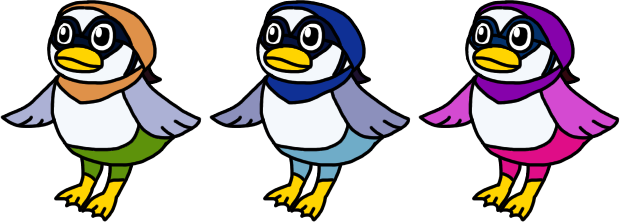
Acroduck is a stocky avian creature. Its plumage is primarily white. The back of the head has some dark feathers, the wings are typically greyish, and the rump and legs are brightly coloured; the hue of these feathers varies between individuals. The beak and feet are yellow. Its wings are short and stubby. It typically wears a cap, eye mask and scarf.
Biology
Despite its short stature and stubby wings, Acroduck is a talented gymnast. It spends a lot of time practising its acrobatic routines to perfect them.
Acroduck is just as capable in the air as in water.
Habitat
Acroduck may be found anywhere that has both water and heights for it to take off from.
Hirudella
WIP
Wondelian
Classification: Light Outsider
Appearance
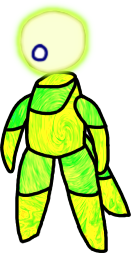
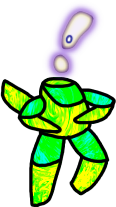
Wondelian is a small humanoid with a glowing body of "hard light". Its main body is swirling yellow-green. Its head can change in shape and texture, but always bears a single eye. At rest, its head takes the form of a plain white sphere. It looks like it has three legs, but one "leg" is actually a tail.
Biology
Wondelian's biology defies classification. Its limbs turn in all kinds of strange ways that don't match its movement.
Its head isn't attached to the rest of its body. It changes the shape of its head to express itself.
If attacked, it can produce bright flashes and energy bursts to protect itself.
Habitat
Wondelian is rarely seen. It keeps appearing and disappearing in strange places. It appears to be attracted to energy sources.
Tadcold → Batracool
Classification: Ice Reptile
Appearance
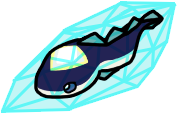
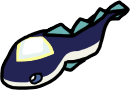
Tadcold is a limbless amphibian larva with a large head. Its body is navy and cream, with pointed teal fins. Its eyes are sparkling blue. Atop its head is a yellow and white diamond shape.
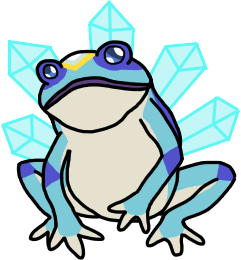
Batracool is a frog-like amphibian. Its body is cyan and indigo above, and cream below. It has sparkling eyes and a yellow-white diamond shape atop the head. On its back are several large ice crystals.
Biology
They won't be hurt even if they're completely encased in ice. In fact, they can use the ice for protection. They are also sensitive to vibrations transmitted through ice, which can warn them of approaching danger long in advance.
Batracool uses its crystals both for offense and defense. If its crystals are broken, it can regenerate them simply by drinking water.
Habitat
They mainly live in cold forests on the forest floor and in ponds.
They are less active during the summer in order to conserve water.
Zaful → Zamjishan → Zawerld
Classification: Null Humanoid
Appearance
Zaful is a small humanoid with a pale gangly body wrapped in a short dark robe covered in colourful floral designs. Its face is masklike but expressive. On the head is a red crest resembling a feather. Its head is covered in messy hair.
Zamjishan is taller and more imposing than Zaful. Its robe is longer and has large sweeping red areas surrounded by intricate natural designs. Its crest, now yellow, is much longer and has twisted into a loose loop, like a halo over Zamjishan's head.
Zawerld is tall and slender. Its robe is very loose and flowy, and is dominated by purple, yet completely covered with tiny colourful details like a tapestry. Its crest has become a large golden wreath.
Biology
Zaful carries a white wand that it uses to harness the elements and manipulate nature. It experiments with its abilities on whatever it finds, occasionally causing trouble by carelessly interfering.
Zamjishan is much more experienced with the use of its wand, but it still wanders in search of knowledge. All kinds of unusual abilities are attributed to Zamjishan in folklore.
Zawerld's every move is incredibly careful and precise, to achieve exactly the result it needs. It is said that Zawerld has infinite knowledge, having seen all the universe. People sometimes go on quests to find it and have their questions answered.
Habitat
They wander everywhere, trying to see as much of the world as possible. Zaful is more often seen around people than Zamjishan, and Zawerld is very rarely seen.
Accelerga → Sawblasta
Classification: Fire Bug
Appearance
Accelerga is a small stocky caterpillar-like insect. Its body is black with orange-yellow chevrons. The surface of its body is thick and padded, as if armoured.
Sawblasta is a bulky flying wasp-like insect. It has two pairs of large glassy wings. Its abdomen ends in a large serrated blade.
Biology
They gather into troops that travel together in formation.
The inside of Accelerga's body is extremely hot. It can produce globs of flammable ooze and spit them out as fireballs to defend itself.
Sawblasta is aggressive and ruthless when fighting over territory. The battles between rival troops occasionally lead to devastating forest fires.
Sawblasta's abdominal blade is well suited for cutting through wood. It uses this to lay eggs in trees under the bark.
Habitat
They mainly live in dry forests and plains.
They are attracted to certain kinds of fire-resistant tree that they feed on.
Spanglar → Lancraftar | Pressyllar
WIP
Snorkid → Scubeast → Submandua
WIP
Heliori
Classification: Light Worm
Appearance

Heliori, in its motile form, is a small indigo worm-like creature. It has one large green eye and several smaller ones, a long rigid grey tail, and a blue flagellum that extends from the front of its body and twists around backwards. On the side of its body are yellow zigzag marks.

In its sessile form, it is rooted to the ground by its tail, it has no flagellum, and the top of its body is enlarged into a globe covered in long appendages bearing sharp prongs. A yellow zigzag mark loops around its body.
Biology
Heliori can sense electricity around it. It can even sense the bioelectricity of other creatures, allowing it to detect incoming predators and prey.
It can transform between two forms, one for travel and one for feeding or defending itself. The whole process takes mere seconds.
In its motile form, its tail is rigid, so it moves solely by beating its long flagellum.
In its sessile form, it can extend its prongs to stab its foe and deliver an electric shock.
It prefers to use its sessile form in combat. If it cannot defeat its foe, it changes back into its motile form and usually flees.
Habitat
Heliori lives in shallow, slow-flowing water. It is rarely seen by humans.